
What is the Grindadráp?
Between those who defend it as a cultural heritage and those who condemn it as a cruel anachronism, the Grindadráp continues to spark global outrage. But what exactly is it? And why, despite international protests, is it still practiced today?
The Grindadráp is an ancient practice of collective whale hunting in the Faroe Islands. It is not traditional fishing — it is a ritual slaughter in which entire herds of pilot whales, highly social and intelligent cetaceans, are exterminated without a chance to escape. Once born out of the need to survive in a harsh environment, the Grindadráp now persists as a symbol of identity… at an extremely high cost to marine life.
How the Hunt Happens
There are no real “hunting rules” or “respect” for the animal. As soon as a herd is spotted, dozens of boats rush out to sea. With roaring engines and man-made waves, they form a wall of terror, forcing the animals into carefully selected bays shaped like funnels. Trapped between water and land, the cetaceans stand no chance.
Hunters, armed with hooks — called blásturkrókur — and sharp knives, grab the animals by their blowholes and drag them ashore. There, their throats are slashed wide open to cause death by exsanguination. Although “humane” killing devices are officially required, witnesses often report prolonged agony — animals writhing for minutes in terror and pain before dying.
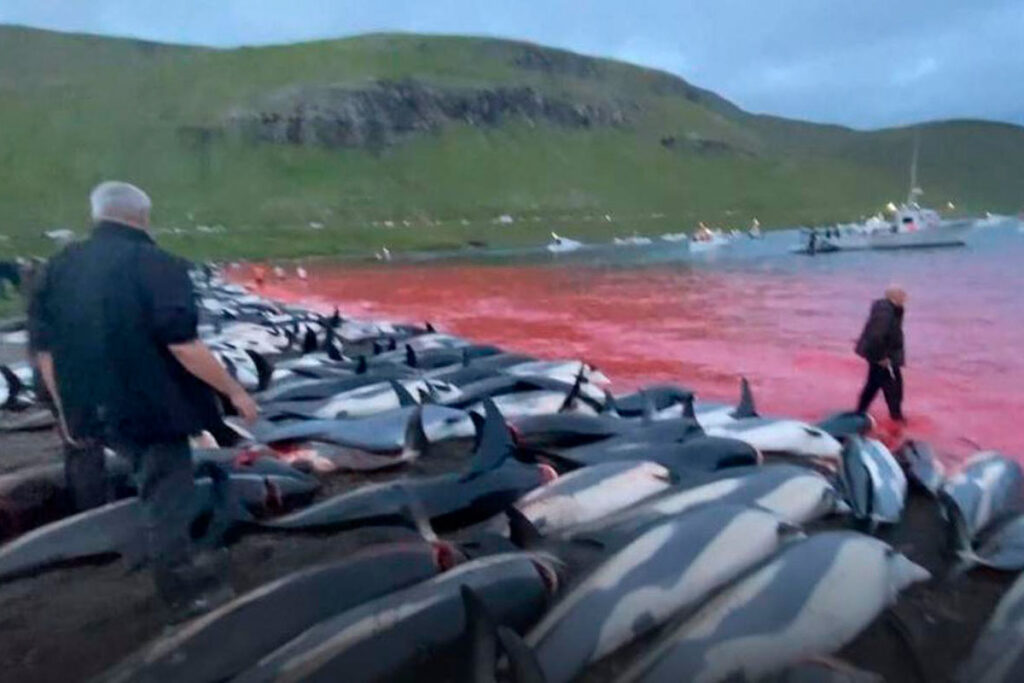
When the Hunt Takes Place
The Grindadráp can happen at any time of year, but it is most frequent in the summer months — from June to September — when the sea is calmer and sightings are more common. There are no real limits: every sighting can turn into a massacre.
Which Cetaceans Are Killed
While the primary targets are long-finned pilot whales (Globicephala melas), other cetaceans are also massacred:
- Atlantic white-sided dolphins (Lagenorhynchus albirostris)
- Common dolphins (Delphinus delphis)
- Bottlenose dolphins (Tursiops truncatus)
- Striped dolphins (Stenella coeruleoalba)
All these species are known for their high intelligence, empathy, and strong social bonds — traits that make their slaughter even more horrific. Some of these dolphins are also found in the Mediterranean. See our article on Mediterranean cetaceans (soon translated).
Laws Exist, but They Don’t Exist
The Faroese authorities claim the Grindadráp is regulated by national laws: Only licensed individuals are allowed to participate. Approved tools must be used to “minimize” suffering. Every hunt must be officially recorded.
And yet, numerous testimonies document repeated violations: brutal methods, prolonged suffering, and unnecessary killings. Inspections are rare and mostly handled internally, with no truly independent observers.
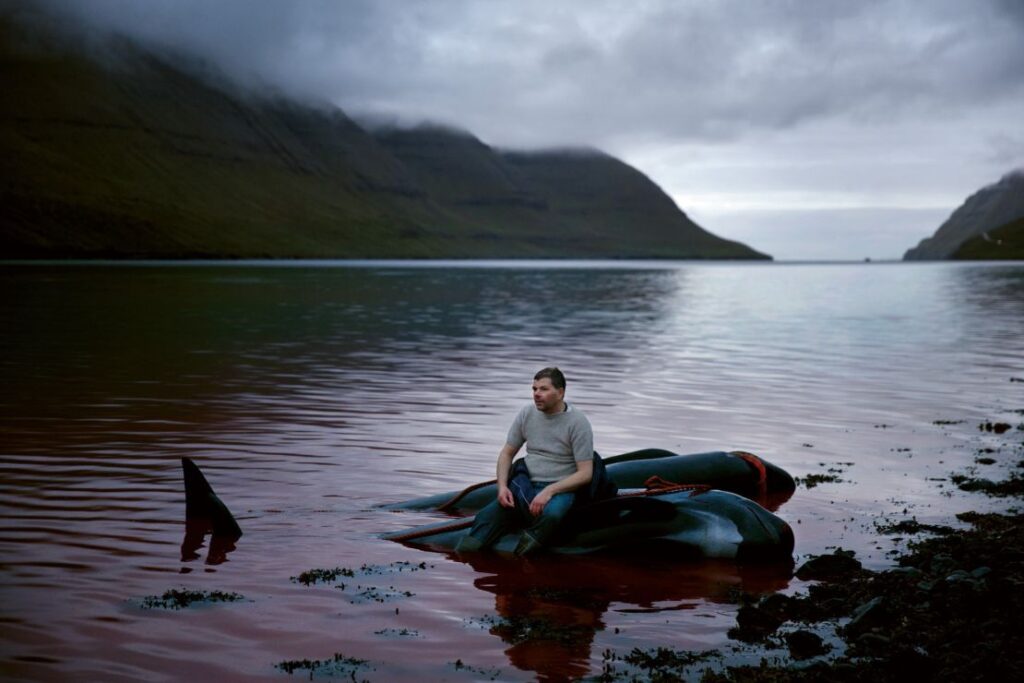
The History of Grindadráp
The Grindadráp dates back over a thousand years, when Viking communities in the Faroes depended entirely on the ocean. At the time, whale meat, fat, and blubber were essential for survival.
Today, in the modern Faroe Islands, that necessity no longer exists. Moreover, whale meat is often contaminated with mercury and other toxins, making it dangerous to consume (as confirmed by Faroese medical studies themselves). Still, the Grindadráp continues — fiercely defended as a matter of “national pride.”
Activism Against the Grindadráp
Organizations such as Sea Shepherd and Whale and Dolphin Conservation have led a relentless fight against the Grindadráp for years:
- They release shocking images to raise public awareness.
- They lobby for diplomatic pressure from European governments and institutions.
- They promote tourism boycotts against the Faroe Islands.
Despite these efforts, local authorities continue to defend the Grindadráp as “sustainable” and “humanely managed.” But the international outcry is growing louder: the world is beginning to see this for what it is — a senseless and outdated massacre.
Last thought
Don’t get me wrong: the Grindadráp is an abomination. There is absolutely no justification for killing cetaceans in such a barbaric and brutal way. If I had the power, I would ban it today. After all, the animals involved could be caught using nets or other methods, as is done with many other marine species.
And it’s precisely those last words I’d like to pause on for a moment: fishing. Because the world is outraged by the cruelty of this event — yet we’re talking about just a few hundred animals.
So why don’t we react the same way to the roughly 10,000 cetaceans killed every year in the Mediterranean alone by commercial fishing? Or to the 100,000 sharks and 150,000 sea turtles that fall victim to industrial fishing practices?
That’s a question I’ll leave to you, the readers.
